 English


Cataract & Ophthalmic Microsurgical Sets: Titanium vs Stainless Pin-Mat Trays
A comparison of lightweight titanium and surgical stainless steel ophthalmic sets organized in silicone pin-mat sterilization trays.
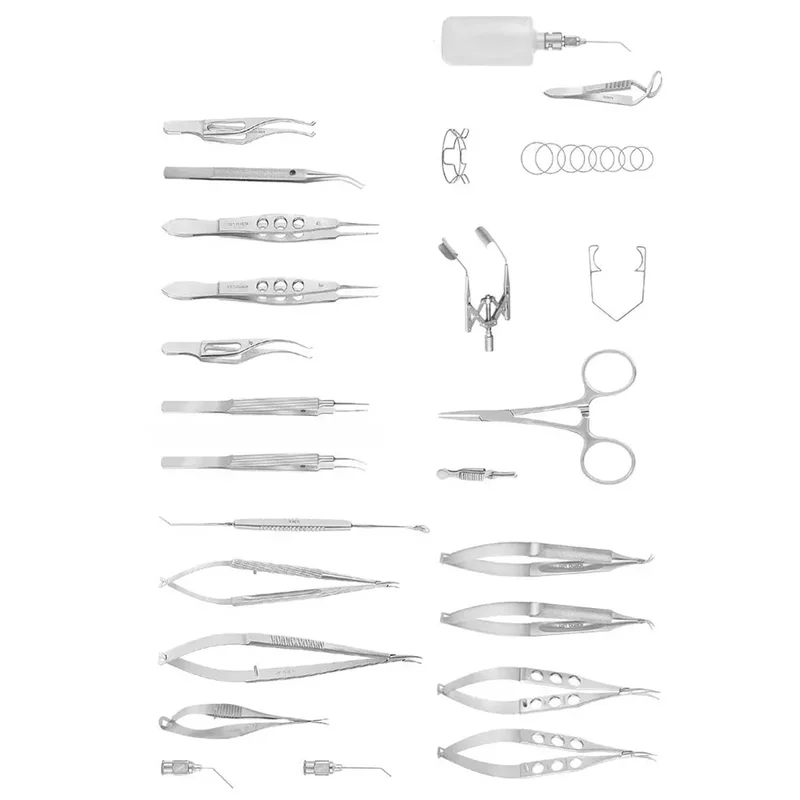
Reviewed against DIN sterilization basket standards, itemized surgical set BOMs, and operating theatre turnaround protocols.
On this page (11)
- Cataract & Ophthalmic Microsurgical Instrument Sets: Titanium vs. Stainless Steel & Silicone Pin-Mat Trays
- Executive Overview and B2B Procurement Context
- Clinical Set Architecture and Application Differences
- Critical Instrument Engineering Specifications
- Material and Metallurgical Engineering
- Technical Comparison: Titanium, Stainless Steel and Tray Protection
- Why Double-Tier Silicone Finger-Mat Trays Are Mandatory for Microsurgical Sets
- Illustrative ECCE/Phacoemulsification BOM and Piece-Count Reconciliation
- Manufacturing and Quality-Control Checkpoints in Sialkot
- Buyer RFQ and Ordering Checklist
- Recommended Procurement Path
Cataract & Ophthalmic Microsurgical Instrument Sets: Titanium vs. Stainless Steel & Silicone Pin-Mat Trays
Executive Overview and B2B Procurement Context
Ophthalmic microsurgical instruments are not interchangeable with general surgical instruments. Corneal forceps, capsulotomy scissors, hooks, speculums and micro-dissectors must maintain controlled tip geometry, atraumatic closing pressure, optical cleanliness and reliable tactile feedback through repeated cleaning, sterilization and handling. A procurement specification that identifies only the instrument name and quantity is therefore insufficient for cataract, strabismus, pterygium or chalazion programs.
For hospitals, distributors and Ministry of Health tender boards, the commercial risk is usually found in four areas: incomplete bill-of-materials reconciliation, substitution of visually similar but functionally different patterns, premature damage to micro-tips during CSSD transport, and unclear material or sterilization claims. Precision Kit World designs complete surgical instrument sets, procedure trays and silicone pin-mat sterilization cassettes with the instrument pattern, quantity, material, finish, packaging and reprocessing pathway defined together.
The correct purchasing decision is not simply titanium versus stainless steel. It is a system decision involving instrument application, jaw and tip geometry, stiffness, corrosion resistance, magnetic response, weight, tray retention, sterilizer cycle, cleaning chemistry, operator preference and expected annual utilization.
- For cataract surgery: tip alignment, low-profile geometry, fine spring action and non-traumatic tissue contact are primary.
- For strabismus surgery: tendon handling, muscle-hook profiles, robust yet delicate scissors and secure grasping surfaces are more important.
- For pterygium and chalazion procedures: dependable dissection, fixation, tissue grasping and compact general ophthalmic functionality are required.
- For CSSD: every micro-instrument must be protected against point loading, tip-to-tip collision, loose movement, tray overloading and incorrect reprocessing.
Instrument names such as “Castroviejo forceps” or “Barraquer speculum” describe families of patterns rather than a single universally controlled design. The RFQ must therefore specify tip width, platform, tooth configuration, length, handle pattern, spring action, surface finish, material and acceptance criteria.
Clinical Set Architecture and Application Differences
ECCE and Phacoemulsification Cataract Set
An ECCE/phacoemulsification set requires instruments for exposure, fixation, corneal incision support, capsulorhexis, hydrodissection assistance, nucleus manipulation, cortical aspiration support, iris management, wound closure and final inspection. A routine phaco set generally uses shorter, lighter and more delicate instruments than a broad ECCE set, while an ECCE configuration may require larger lens-loop, vectis or nucleus-delivery patterns.
The final configuration must be agreed with the ophthalmic surgeon because phaco systems vary in handpiece design, incision size, side-port approach and use of disposable cannulas. Precision Kit World can separate reusable instruments from customer-supplied or single-use items so that the reusable BOM is not inflated by components that are not included in the sterilization cassette.
Strabismus Set
A strabismus set is built around extraocular muscle identification, isolation, traction, dissection and suturing. It normally requires muscle hooks in multiple profiles, fine-toothed or atraumatic forceps, Westcott-type scissors, conjunctival forceps, needle holders and a speculum suitable for the surgical field. The set should not be supplied as a cataract set with a few muscle hooks added; jaw geometry, handle length and instrument balance are different.
Hooks should be specified by shaft diameter, hook radius, tip termination and atraumatic finish. A sharp transition at the hook tip can catch or tear muscle tissue. Forceps should be evaluated for controlled closure, tooth alignment and absence of lateral jaw offset under moderate hand pressure.
Pterygium and Chalazion Set
Pterygium surgery requires instruments for conjunctival fixation, tissue elevation, blunt and sharp dissection, graft handling and suturing. A chalazion set is more compact and typically emphasizes a chalazion clamp, fine scissors, small forceps, curette and lid retraction or stabilization instruments. A combined pterygium/chalazion tray should be organized into clearly identified subassemblies to prevent unnecessary instruments being opened for a minor lid procedure.
Where a hospital purchases a combined ophthalmic tray, the BOM should state which components are required for every case and which are optional modules. This improves sterile field control, reduces reprocessing workload and gives procurement teams a defensible piece-count reconciliation.
Critical Instrument Engineering Specifications
0.12 mm Castroviejo and Colibri Corneal Forceps
“0.12 mm” should be treated as a controlled functional dimension, not as a complete product description. The RFQ should define whether 0.12 mm refers to the tooth or tip width, the tooth pitch, the platform thickness or the nominal grasping element. For reliable manufacturing, the drawing should identify the datum surfaces and the measurement method.
- Tip configuration: 0.12 mm nominal atraumatic tooth or tip specification, with the drawing defining whether the pattern is 1 x 2, 2 x 2, tying, non-toothed or platformed.
- Tip alignment: target lateral mismatch of not more than 0.05 mm at the final 2 mm of the working tip unless the validated pattern requires another value.
- Tying platform: platform width, length and edge radius must be specified separately; a tying platform is not equivalent to a standard corneal forceps jaw.
- Surface: no burrs, sharp unintended edges, abrasive marks or crown deformation on the tissue-contacting surfaces.
- Spring action: closing force should be validated at a defined opening, commonly 5 mm, with a project-specific target range rather than an unqualified “soft” or “medium” spring.
- Inspection: optical magnification of at least 10x is recommended for tip inspection, with a calibrated optical comparator or vision system used for critical dimensions.
Vannas Capsulotomy Spring Scissors
Vannas scissors are highly sensitive to blade alignment, pivot friction and cutting engagement. The blades should meet progressively from the distal tip toward the proximal cutting region without a visible gap at the defined inspection position. The cutting test must use a controlled substrate or validated ophthalmic test medium; casual cutting of paper does not prove capsulotomy performance.
- Blade length, overall length, shank profile and angled or straight configuration must be included on the drawing.
- Target blade edge alignment should be controlled to approximately 0.05 mm or better at the working tip where the design permits.
- Pivot torque should be measured after cleaning and sterilization simulation, with no binding, lateral wobble or uncontrolled snap-through.
- Spring handles should return consistently without permanent set after repeated open-close cycling.
- Cutting performance should be verified before and after a defined durability cycle, such as 500 to 1,000 open-close cycles, followed by ultrasonic cleaning and steam exposure.
Barraquer and Lieberman Wire Eye Speculums
Wire speculums must provide predictable eyelid retraction without exposed wire ends, abrupt bends or unstable hinge action. The design specification should identify blade or wire diameter, spread range, closed width, working depth, retraction angle and spring or screw mechanism.
For wire patterns, a common engineering target is a wire diameter tolerance of plus or minus 0.05 mm, with the actual tolerance established by the approved drawing and validated against tissue-contact requirements. The finished wire must be continuously smooth at a minimum of 10x magnification. The speculum should maintain its defined spread after repeated cycling and should not exhibit permanent deformation after the specified sterilization exposure.
Sinskey Hooks and Micro-Manipulators
A Sinskey hook is a point-contact instrument. The distal hook radius, shaft angle and tip diameter directly affect capsular or intraocular manipulation. A tip that is nominally correct but rounded inconsistently can change the tactile response and clinical use.
- Specify straight, angled or offset shaft geometry.
- Define tip diameter, hook radius, shaft diameter and working length.
- Control the distal tip under 10x to 20x magnification, depending on the approved drawing.
- Require a smooth, non-cutting tip unless the pattern is intentionally designed otherwise.
- Confirm that the handle does not rotate relative to the shaft during a controlled torsion test.
Material and Metallurgical Engineering
Stainless Steel
Stainless steel remains the most widely specified material for reusable ophthalmic instruments because it offers high stiffness, predictable elastic response, broad availability and established compatibility with saturated steam sterilization. Common instrument grades include martensitic stainless steels for cutting edges and spring components and austenitic stainless steels for selected corrosion-resistant components.
The purchase specification should identify the grade or an approved equivalent rather than accepting “medical stainless steel” as a sufficient description. ASTM F899 provides a recognized framework for stainless steel used in surgical instruments. ASTM A276 may be referenced for stainless steel bar and machined stock, while the manufacturer should retain heat or material certificates for critical production lots.
- Typical martensitic instrument steel: a 400-series surgical grade selected for hardness, edge retention and spring response.
- Typical corrosion-resistant component steel: a suitable austenitic or precipitation-resistant grade where the design requires greater corrosion resistance or non-hardening behavior.
- Passivation: nitric or citric passivation should be controlled under the approved process, with rinse quality and post-passivation inspection recorded.
- Surface finish: specify satin, matte, electropolished or mirror finish by location; a lower-reflectivity matte finish may improve microscope-field handling.
- Corrosion verification: use a defined accelerated exposure or cyclic steam test rather than a generic statement that the instrument is rustproof.
Titanium
Titanium instruments are valued for low density, corrosion resistance, reduced magnetic response and excellent compatibility with demanding steam reprocessing. Commercially pure titanium may be used where forming and corrosion resistance are primary. Ti-6Al-4V, commonly referenced to ASTM F136 for wrought alloy applications, provides higher strength but requires careful control of machining, burr removal and surface finish.
Titanium is not automatically superior for every instrument. Its lower modulus compared with stainless steel can produce a different spring feel and may require a larger cross-section or revised geometry to achieve the same stiffness. Titanium surfaces can also show galling or marking if the pivot design, finish and lubrication protocol are poorly controlled.
Silicone Pin-Mat Tray Material
The silicone mat should be medical-grade, platinum-cured or otherwise controlled under a documented material specification. The specification should state hardness, colorant, temperature range, compression set, tear resistance, cleanliness and compatibility with the selected cleaning and sterilization chemistry.
A practical tray specification may require a nominal silicone hardness of 50 to 70 Shore A, a continuous-use range that includes 134 degrees Celsius saturated steam, and dimensional stability after repeated validated cycles. The final requirement must be confirmed by the tray manufacturer through sterilization simulation, because hardness alone does not predict retention behavior.
Technical Comparison: Titanium, Stainless Steel and Tray Protection
| Specification area | Stainless steel instrument | Titanium instrument | Silicone pin-mat tray requirement | Recommended buyer acceptance criterion |
|---|---|---|---|---|
| Typical material reference | ASTM F899 instrument grade; approved 400-series or corrosion-resistant grade | Commercially pure titanium or Ti-6Al-4V, with applicable material certificate such as ASTM F136 | Medical-grade silicone under a controlled compound specification | Material grade, heat or lot certificate and approved drawing recorded in the technical file |
| Density and handling | Approximately 7.7 to 8.0 g/cm³; higher mass and familiar stiffness | Approximately 4.4 to 4.5 g/cm³; lower mass and reduced magnetic response | Negligible structural load; must support instruments without masking inspection | Finished tray weight and instrument balance confirmed against the approved sample |
| Critical dimensional control | Micro-tip mismatch target not more than 0.05 mm where applicable; cutting edge and jaw geometry drawing-controlled | Same functional tip target, with additional control of spring deflection and machined burr removal | Pin spacing and retention geometry typically controlled to approximately plus or minus 0.25 mm unless validated otherwise | 100 percent visual inspection of working tips; calibrated dimensional inspection on defined sampling or critical features |
| Steam sterilization compatibility | Compatible with validated saturated steam cycles when cleaned, dried and passivated correctly | Compatible with validated saturated steam cycles; finish and pivot design remain critical | Must be validated for the hospital cycle, commonly 121 or 132 to 135 degrees Celsius, including drying | Cycle exposure test with no distortion, tackiness, cracking, corrosion or loss of retention |
| Corrosion and chemical resistance | Dependent on alloy, passivation, chloride exposure, detergent concentration and drying | Generally excellent corrosion resistance, but contamination and surface damage remain possible | Must tolerate the approved detergent, enzymatic cleaner and disinfectant without swelling or embrittlement | Documented cleaning chemistry limits and post-cycle visual inspection |
| Magnetic response | Varies by alloy and cold work; may be relevant near magnetic equipment | Low magnetic response compared with most stainless instrument grades | Not applicable, but tray hardware must not create a retention hazard | State magnetic requirement only when clinically or operationally necessary |
| CSSD transport risk | Micro-tips can collide if loose, stacked or placed in a flat perforated tray | Micro-tips can still collide; lower weight does not eliminate impact damage | Double-tier finger or pin-mat retention with separated levels and defined instrument locations | No tip-to-tip contact during controlled movement, inversion simulation and tray stacking test |
Why Double-Tier Silicone Finger-Mat Trays Are Mandatory for Microsurgical Sets
For complete microsurgical sets, a flat perforated tray or a single layer of loose silicone inserts is inadequate. During CSSD transport, carts accelerate, stop, turn and pass over uneven surfaces. Micro-forceps, Vannas scissors, hooks and needle holders can shift, rotate and strike one another. A collision that is invisible at normal viewing distance can produce a bent 0.12 mm tip, a damaged tying platform, a misaligned scissors blade or a burr that is clinically unacceptable.
A double-tier silicone finger-mat tray creates vertical and lateral separation. The lower mat supports instrument bodies, while the upper finger or pin layer retains handles and shafts in defined channels. The two levels prevent instruments from sliding into a common impact plane and reduce the risk that a heavy instrument will rest on a delicate distal tip.
- Tier separation: the vertical clearance must exceed the maximum local instrument height with an engineering safety margin, not merely match the nominal instrument thickness.
- Tip clearance: each micro-tip must remain suspended or seated without contact with adjacent tips, tray metal or the lid.
- Location control: every instrument location should be identified by pattern, length and orientation, with no ambiguous shared pocket for different tip geometries.
- Retention force: silicone fingers should hold instruments during transport but release them without excessive bending force or scraping.
- Inspection access: the tray must permit visual confirmation that all instruments are present, open where required and not trapped under an adjacent handle.
- Stacking: the lid and tray frame must prevent compression of the upper mat when another container is placed above it.
“Mandatory” in this context means mandatory for a validated Precision Kit World microsurgical transport and sterilization configuration where the risk assessment identifies micro-tip collision as a foreseeable failure mode. The tray is not a substitute for cleaning validation, proper loading or a sterilizer cycle validated under ISO 17665-1. It is a mechanical protection control within the complete CSSD system.
Illustrative ECCE/Phacoemulsification BOM and Piece-Count Reconciliation
The following is an engineering example for a reusable core cataract set. The final BOM must be adapted to the surgeon’s phaco platform, incision strategy, preferred forceps pattern and whether cannulas, blades, aspiration tubing or other single-use items are excluded.
| Line | Instrument or tray component | Specification summary | Material or finish | Quantity |
|---|---|---|---|---|
| 1 | Barraquer wire eye speculum | Adult, spring type, smooth wire, defined spread and working depth | Stainless steel or titanium; satin finish | 1 |
| 2 | Colibri corneal forceps | 0.12 mm atraumatic tips; tying platform if required | Titanium or surgical stainless steel | 1 |
| 3 | Castroviejo tying forceps | Fine platform, specified tooth configuration and tip width | Titanium or surgical stainless steel | 1 |
| 4 | Capsulorhexis forceps | Fine curved or angled tip; surgeon-approved jaw geometry | Titanium or surgical stainless steel | 1 |
| 5 | Vannas capsulotomy scissors | Spring handle; straight or curved; controlled blade engagement | Stainless steel or titanium | 1 |
| 6 | Westcott or conjunctival scissors | Fine blunt-point or sharp-point configuration | Stainless steel | 1 |
| 7 | Sinskey hook | Specified shaft angle, hook radius and tip diameter | Titanium or stainless steel | 1 |
| 8 | Micro iris spatula | Rounded atraumatic working end | Titanium or stainless steel | 1 |
| 9 | Fine iris forceps | Atraumatic or toothed pattern as clinically specified | Titanium or stainless steel | 1 |
| 10 | Lens loop or vectis | Pattern, loop width and shaft profile defined by surgeon | Stainless steel or titanium | 1 |
| 11 | Hydrodissection cannula | Reusable only if expressly requested; gauge and tip angle specified | Stainless steel | 1 |
| 12 | Viscoelastic cannula | Gauge, hub and tip geometry specified | Stainless steel | 1 |
| 13 | Simcoe or irrigation-aspiration cannula | Gauge, port arrangement and tubing interface specified | Stainless steel | 1 |
| 14 | Fine needle holder | Approximate 12 to 14 cm class; jaw length and insert pattern specified | Tungsten-carbide insert only if required | 1 |
| 15 | Micro tying forceps | Fine platform for corneal or conjunctival sutures | Titanium or stainless steel | 1 |
| 16 | Double-tier silicone pin-mat cassette | Individual retention locations, lid, label plate and drainage access | Medical-grade silicone with stainless frame | 1 |
| 17 | Instrument identification card | Set code, revision, quantity and inspection status | Laser-marked or autoclavable label | 1 |
Illustrative reconciled total: 16 instruments plus 1 double-tier silicone pin-mat cassette and 1 identification card. If the purchase order states 18 pieces, the buyer should clarify whether the cassette and card are counted as components or whether two additional instruments are required. Precision Kit World recommends issuing a BOM with separate columns for instrument quantity, tray quantity, accessories, consumables excluded and total physical pieces.
Manufacturing and Quality-Control Checkpoints in Sialkot
Design Transfer and Material Control
- Review the customer drawing, approved sample, instrument pattern, material grade, finish, overall length and functional dimensions before production release.
- Assign a controlled part number and revision to each instrument and tray component.
- Verify incoming bar, sheet, wire, tube, silicone and fastener materials against purchase specifications and certificates.
- Separate stainless steel and titanium work-in-process to prevent material mix-up, cross-contamination and incorrect finishing.
Machining, Forming and Finishing
- Use controlled jigs for forceps tips, scissor blades, speculum wires and hook geometry.
- Remove burrs before final assembly, particularly at the distal 2 mm of corneal forceps, hooks and cannula openings.
- Control pivot holes, screw seating, spring alignment and jaw parallelism through in-process gauges.
- Use passivation or electropolishing parameters appropriate to the selected stainless steel grade.
- For titanium, control tool wear, galling, surface contamination and edge rollover during micro-machining.
- Inspect silicone mats for flash, tears, incomplete molding, blocked drainage holes, inconsistent fingers and contamination.
Inline Dimensional and Functional Inspection
Critical dimensions should be checked with calibrated instruments traceable to a quality system consistent with ISO 13485. Depending on the feature, suitable equipment includes digital optical comparators, profile projectors, calibrated microscopes, pin gauges, micrometers, force gauges, torque testers and vision inspection systems.
- Inspect 100 percent of micro-tip forceps, Vannas scissors, hooks and needle-holder jaws under magnification.
- Record tip width, lateral mismatch, tooth engagement, jaw closure, blade alignment and platform condition.
- Measure opening force, closing force or spring return against the approved functional range.
- Check wire speculum spread, symmetry, hinge smoothness and permanent set after cycling.
- Verify cassette pocket position, tier clearance, mat retention and lid compression before final packing.
Durability and Reprocessing Simulation
A commercial qualification plan should expose representative instruments and trays to the hospital’s intended cleaning and sterilization process. The protocol may include repeated manual or automated cleaning, ultrasonic cleaning where permitted, drying, saturated steam sterilization at the selected cycle and controlled transport simulation.
- Use ISO 17664-1 principles when preparing manufacturer reprocessing information for reusable devices.
- Validate steam sterilization using a cycle appropriate to the device and healthcare facility, with ISO 17665-1 as the relevant sterilization framework.
- Use repeated open-close cycling for scissors, spring forceps, needle holders and speculums.
- Inspect for corrosion, discoloration, pitting, loss of alignment, spring fatigue, silicone cracking, mat deformation and label deterioration.
- Perform a transport vibration or inversion test with the loaded double-tier cassette to demonstrate that micro-tips do not collide.
Buyer RFQ and Ordering Checklist
A technically complete RFQ reduces sample revisions, prevents substitutions and allows a meaningful comparison between manufacturers. The following parameters should be stated for every ophthalmic set:
- Procedure: ECCE, phacoemulsification, combined ECCE/phaco, strabismus, pterygium, chalazion or a defined modular combination.
- Instrument list: instrument name, pattern, quantity, overall length, working length, tip angle and left or right orientation where relevant.
- Forceps details: 0.12 mm interpretation, tooth configuration, tying platform dimensions, platform edge radius and required atraumatic performance.
- Scissors details: Vannas or other pattern, blade length, straight or curved profile, sharp or blunt point, spring tension and cutting test.
- Speculum details: Barraquer or Lieberman pattern, wire diameter, spread range, working depth, hinge or spring type and tissue-contact finish.
- Hook details: Sinskey or muscle hook profile, shaft diameter, distal radius, tip diameter and offset angle.
- Material: specific stainless steel grade or titanium grade, certificate requirement, finish and magnetic response requirement.
- Dimensional tolerances: identify critical dimensions and allowable limits; do not rely on “standard size.”
- Functional acceptance: jaw alignment, tip closure, spring force, blade engagement, hook smoothness and speculum cycling.
- Tray design: double-tier silicone finger-mat construction, individual locations, lid type, drainage, stacking limits, labeling and cassette dimensions.
- CSSD process: manual or automated cleaning, ultrasonic cleaning permission, detergent chemistry, steam temperature, exposure time, drying method and packaging system.
- Documentation: BOM, drawing revision, material certificates, inspection report, cleaning instructions, sterilization instructions and certificate of conformity.
- Sampling: request one fully loaded tray and representative samples of the most delicate items, including 0.12 mm forceps and Vannas scissors.
- Piece-count reconciliation: require separate totals for instruments, trays, accessories, identification cards and excluded consumables.
- Commercial terms: sample approval process, minimum order quantity, replacement policy, lead time, packaging, private labeling and spare-part availability.
Recommended Procurement Path
Hospital and distributor buyers should approve the instrument geometry and the CSSD cassette together. A sample instrument that performs well in an open tray may fail after transport if the retention system permits tip contact. Conversely, a well-designed silicone cassette cannot compensate for poor jaw alignment, uncontrolled material substitution or an incomplete BOM.
Review the complete surgical instrument sets portfolio, compare modular surgical sets, and review Precision Kit World manufacturing and quality systems before issuing a technical RFQ. Distributors can request configuration and private-label support through the distributor program. For a drawing review, sample request or tender-specific piece-count reconciliation, contact the Precision Kit World engineering team through the contact page.
Related Categories & Sourcing Hubs
Dr. Hira Khalid
Ophthalmic & Reconstructive Procedure Set Specialist
Reviewed against DIN sterilization basket standards, itemized surgical set BOMs, and operating theatre turnaround protocols.