
 English


Major General Laparotomy Instrument Sets: Complete Hospital Tray & Retractor Guide
A practical surgical tray planning guide for OR supervisors and procurement teams on configuring comprehensive laparotomy sets.
Reviewed against DIN sterilization basket standards, itemized surgical set BOMs, and operating theatre turnaround protocols.
On this page (12)
- Major General Laparotomy Instrument Set: Complete Hospital BOM, Retractor Pairings & CSSD Tray Layout
- Executive Overview and B2B Procurement Context
- Defined 75-Piece Instrument BOM
- Functional Zone Engineering
- Recommended Ring-Stringer Ordering for Rapid Count Verification
- Material, Metallurgical, and Surface Engineering Specification
- Manufacturing and Quality-Control Checkpoints in Sialkot
- CSSD Sterilization Cassette and Tray Layout
- CSSD Inspection and Reprocessing Controls
- Buyer RFQ and Sample-Approval Checklist
- Recommended Spare-Instrument Policy
- Procurement Conclusion
Major General Laparotomy Instrument Set: Complete Hospital BOM, Retractor Pairings & CSSD Tray Layout
Executive Overview and B2B Procurement Context
The Major General Laparotomy Instrument Set is a high-volume open abdominal surgery configuration intended for exploratory laparotomy, bowel resection, intestinal anastomosis, adhesiolysis, abdominal trauma, gynecologic abdominal access, and comparable procedures requiring broad exposure, controlled hemostasis, atraumatic tissue handling, and secure closure.
This specification defines a reconciled 75-piece working instrument BOM. The count includes reusable surgical instruments only. The sterilization tray, lid, silicone instrument mats, identification labels, ring-stringers, count tags, and any disposable scalpel blades or suture materials are excluded from the 75-piece instrument count unless specifically added to the purchase order.
For hospital procurement departments, the value of a reconciled BOM is operational rather than cosmetic. Every item must be countable at the scrub table, traceable during decontamination, positioned consistently in the CSSD cassette, and matched to a documented inspection and replacement process. For distributors and Ministry of Health tender boards, an exact piece count prevents ambiguity between a nominal “75-piece set” and a delivered set that contains duplicated low-value instruments while omitting essential deep exposure or closure instruments.
Precision Kit World manufactures complete surgical instrument sets and procedural trays in Sialkot with controlled BOM documentation, instrument marking options, inspection records, and packaging configurations suitable for institutional procurement. Related product information is available through the surgical instrument sets and complete surgical sets pages.
Defined 75-Piece Instrument BOM
The following configuration is a balanced general laparotomy set. Quantities may be adapted to the hospital’s surgeon preference, procedure mix, and local tender specification, but any change should be documented as a controlled BOM revision rather than an informal substitution.
| Zone | Instrument family | Specification | Quantity | Running total | Count-control purpose |
|---|---|---|---|---|---|
| Incision and dissection | Scalpel handles | No. 3, 2; No. 4, 2 | 4 | 4 | Separate handles from disposable blades during count |
| Incision and dissection | Mayo scissors | Heavy, straight, 17 cm, 1; curved, 17 cm, 2 | 3 | 7 | General cutting and suture-material handling |
| Incision and dissection | Metzenbaum scissors | Curved, 18 cm, 2 | 2 | 9 | Fine soft-tissue dissection |
| Incision and dissection | Dissecting forceps | Toothed, 14.5 cm, 2; Adson toothed, 12 cm, 1 | 3 | 12 | Skin and fascial edge handling |
| Hemostasis | Mosquito artery forceps | 12.5 cm, straight, 6; curved, 6 | 12 | 24 | Fine vessel control; first hemostat stringer |
| Hemostasis | Kelly artery forceps | 14 cm, straight, 4; curved, 4 | 8 | 32 | Medium vessel and pedicle control |
| Hemostasis | Crile artery forceps | 14 cm, straight, 3; curved, 3 | 6 | 38 | Full transverse serration and general clamping |
| Hemostasis | Kocher forceps | Toothed, 14 cm, straight, 2; curved, 2 | 4 | 42 | Fascia, tough tissue, and secure traction |
| Atraumatic tissue handling | Babcock forceps | Fenestrated, atraumatic, 16 cm, 4 | 4 | 46 | Bowel and tubular tissue handling |
| Atraumatic tissue handling | Allis tissue forceps | 5 x 6 teeth, 15 cm, 4 | 4 | 50 | Fascia, peritoneum, and tissue-edge traction |
| Atraumatic tissue handling | DeBakey forceps | Atraumatic, 20 cm, 2 | 2 | 52 | Vascular or bowel-adjacent tissue manipulation |
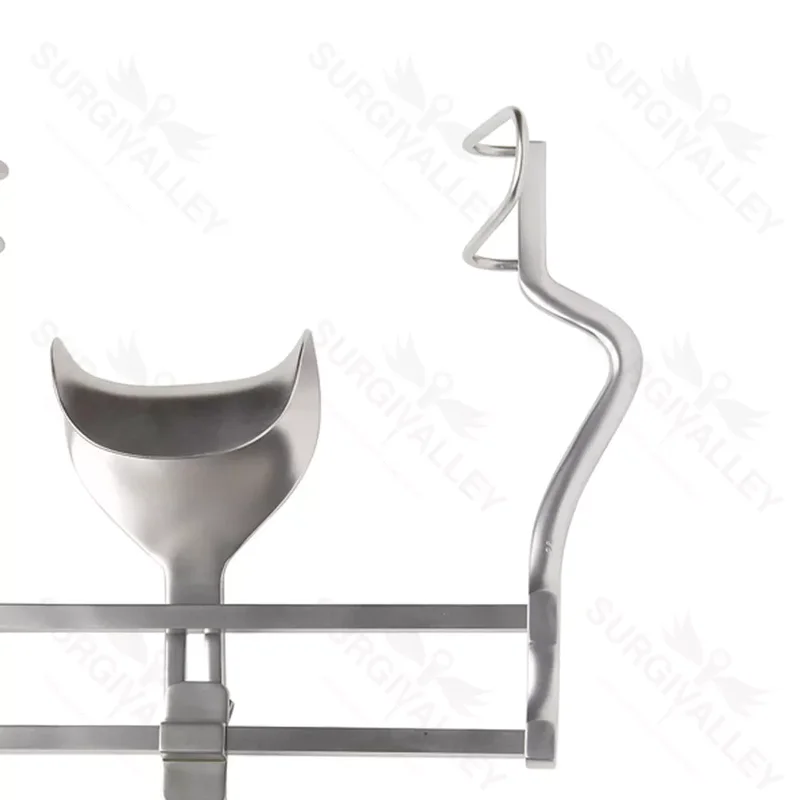
| Deep exposure | Balfour abdominal retractor | Self-retaining frame with 3 blades | 1 | 53 | Primary self-retaining abdominal exposure |
| Deep exposure | Deaver retractors | Blunt, 38 mm, 1; 50 mm, 1; 76 mm, 1 | 3 | 56 | Variable-depth lateral and pelvic retraction |
| Deep exposure | Richardson retractors | Double-ended, 25 mm, 2 | 2 | 58 | Superficial-to-intermediate wound-edge exposure |
| Deep exposure | Eastman retractors | Double-ended, 38 mm, 2 | 2 | 60 | Deep abdominal wall and pelvic exposure |
| Deep exposure | Harrington retractor | Blunt, 28 cm, 1 | 1 | 61 | Deep organ displacement and visualization |
| Closure and accessories | TC needle holders | Mayo-Hegar, 16 cm, 2; Mayo-Hegar, 20 cm, 1; Olsen-Hegar, 18 cm, 1; long curved needle holder, 20 cm, 1 | 5 | 66 | Fascial, bowel, and deep closure control |
| Closure and accessories | Suture scissors | Sharp/blunt, 14 cm, 2 | 2 | 68 | Suture cutting without compromising needle holders |
| Closure and accessories | Sponge-holding forceps | Ring-handled, 24 cm, 3 | 3 | 71 | Swab handling and cavity preparation |
| Closure and accessories | Towel clamps | Sharp-point, 13 cm, 4 | 4 | 75 | Drape fixation and field organization |
BOM reconciliation: Incision and dissection 12 pieces + hemostasis 30 pieces + atraumatic tissue handling 10 pieces + deep exposure 9 pieces + closure and accessories 14 pieces = 75 pieces.
Functional Zone Engineering
Incision and Dissection Zone
The incision and dissection group combines scalpel handles, Mayo scissors, Metzenbaum scissors, toothed dissecting forceps, and Adson forceps. The No. 3 and No. 4 handle combination accommodates routine skin incision, longer blades, and heavier abdominal access. If blades are supplied, they should be separately listed as disposable components and should not be counted as reusable instruments.
Mayo scissors require a robust box lock and consistent blade engagement for fascia, sutures, and heavier tissue. Metzenbaum scissors should be reserved for soft-tissue dissection and should not be used to cut wire, drapes, or heavy suture. The procurement specification should distinguish sharp/sharp, sharp/blunt, straight, and curved patterns because these are not interchangeable for surgical or count purposes.
Hemostasis Stringers
The hemostasis group contains 30 instruments and should be arranged as four visually distinct ring-stringers or numbered instrument lines:
- Stringer H1: 6 straight Mosquito forceps followed by 6 curved Mosquito forceps.
- Stringer H2: 4 straight Kelly forceps followed by 4 curved Kelly forceps.
- Stringer H3: 3 straight Crile forceps followed by 3 curved Crile forceps.
- Stringer H4: 2 straight Kocher forceps followed by 2 curved Kocher forceps.
Each stringer should maintain a consistent orientation: rings facing the loading operator, ratchet boxes aligned, tips pointing in the same direction, and curved patterns nested in a designated row. This permits a scrub nurse or CSSD technician to verify family, curvature, quantity, and gross condition without unloading the entire tray.
Ring-stringers are organizational devices and are not included in the 75-piece instrument count. If the hospital requires stainless-steel or polymer stringers, they should be listed as tray accessories with their own quantity and material specification.
Atraumatic Bowel and Tissue Handling
Babcock forceps provide fenestrated, atraumatic handling of bowel and tubular structures. The jaws must close symmetrically with no sharp internal corner, burr, or excessive tooth effect. Allis forceps are intentionally more grasping and should be clearly segregated from Babcock instruments to prevent inappropriate tissue selection. DeBakey forceps should have smooth atraumatic serrations and a controlled spring response, particularly where bowel or vascular-adjacent tissue is handled.
The procurement document should not replace Babcock with generic “intestinal forceps.” Jaw pattern, fenestration, overall length, tip width, and atraumatic profile should be explicitly stated.
Deep Exposure and Retractor Pairings
The Balfour retractor is the primary self-retaining exposure platform. It should be paired with the supplied lateral blades and, where specified, a bladder or pelvic blade. Deaver retractors provide manual broad-surface retraction and should be supplied in at least three blade depths so the surgical team can move from abdominal wall exposure to pelvic or subcostal exposure.
| Exposure requirement | Primary retractor | Recommended pairing | Engineering consideration | CSSD layout position |
|---|---|---|---|---|
| General midline laparotomy | Balfour frame | Standard lateral blades plus pelvic blade | Locking mechanism must hold under manual loading without cam-back | Tray base, separated from delicate forceps |
| Upper abdominal or subcostal exposure | Wide Deaver | 76 mm blade with Harrington retractor | Blade must remain smooth and free of edge nicks | Lower lateral channel |
| Pelvic exposure | Eastman retractor | 38 mm double-ended pattern with long Deaver | Handle-to-blade junction requires fatigue and weld inspection | Deep exposure row |
| Abdominal wall exposure | Richardson retractor | 25 mm double-ended pattern with Balfour frame | Blade angle and back surface must be consistent | Retractor divider or side rack |
| Organ displacement | Harrington retractor | Wide Deaver or pelvic blade | Rounded atraumatic tip and controlled stiffness | Dedicated long-instrument channel |
TC Closure Needle Holders
Tungsten-carbide-inserted needle holders should be positioned in the closure zone and not mixed with general hemostats. The TC insert must be securely retained, evenly seated, and free from chipped corners. The jaw texture should hold the specified needle without crushing, spinning, or lateral escape at the working load.
The 16 cm Mayo-Hegar models cover routine closure, the 20 cm model supports deeper abdominal work, and the Olsen-Hegar combines needle holding with an integrated suture-cutting function. The tender should state whether the TC jaws are longitudinally grooved, cross-serrated, or supplied in another validated pattern.
Recommended Ring-Stringer Ordering for Rapid Count Verification
A practical count architecture uses instrument families rather than an arbitrary mixed loading sequence. The following layout is suitable for a scrub nurse count and a post-wash CSSD count.
| Stringer or tray lane | Instrument sequence | Quantity | Identification method |
|---|---|---|---|
| A1: cutting and dissection | Scalpel handles, Mayo scissors, Metzenbaum scissors, dissecting forceps, Adson forceps | 12 | Printed or laser-marked lane card |
| H1: fine hemostasis | Straight Mosquito, then curved Mosquito | 12 | H1 tag and quantity card |
| H2: medium hemostasis | Straight Kelly, then curved Kelly | 8 | H2 tag and quantity card |
| H3: full-serration hemostasis | Straight Crile, then curved Crile | 6 | H3 tag and quantity card |
| H4: toothed hemostasis | Straight Kocher, then curved Kocher | 4 | H4 tag and quantity card |
| T1: tissue handling | Babcock, Allis, and DeBakey forceps | 10 | T1 tag with family subcounts |
| R1: retractors | Balfour, Deaver, Richardson, Eastman, and Harrington patterns | 9 | R1 layout card with blade sizes |
| C1: closure and accessories | TC needle holders, suture scissors, sponge forceps, and towel clamps | 14 | C1 tag with instrument-specific subcounts |
For the operating room, the count card should show the expected quantity by family and curvature. For CSSD, the same card should additionally show length, jaw pattern, and visual inspection points. A replacement item should not be inserted into a set without updating the controlled BOM and tray count card.
Material, Metallurgical, and Surface Engineering Specification
Reusable surgical instruments should be manufactured from corrosion-resistant stainless steels selected according to function. The material declaration should identify the grade or grade family rather than simply stating “surgical stainless steel.” Material selection and verification should be aligned with ISO 7153-1 and applicable stainless-steel requirements such as ASTM F899, with the final grade confirmed by the manufacturer’s material-control procedure.
| Component or property | Recommended specification | Target or tolerance | Verification method | Procurement evidence |
|---|---|---|---|---|
| General martensitic instrument body | AISI 410 or 420 stainless steel, or documented equivalent | Material grade traceability for each production lot | Mill certificate review and positive material identification when required | Material certificate and lot record |
| Atraumatic forceps and corrosion-sensitive components | Documented stainless grade selected for corrosion resistance and elastic response | Grade to be declared in technical file; no unapproved substitution | Certificate review and hardness verification | Grade declaration and inspection report |
| TC needle-holder inserts | Tungsten-carbide inserts, mechanically retained or validated brazed construction | Insert seating flush to approximately 0.05 mm maximum proudness at the working edge | 10x visual inspection, jaw alignment, retention and functional grip test | TC insert inspection record |
| Instrument hardness | Martensitic cutting and clamping components | Typical controlled range 42–52 HRC, subject to design and material | Rockwell C testing on representative samples or approved test coupons | Heat-treatment and hardness report |
| Jaw alignment | Hemostats and needle holders | Tip mismatch target not greater than 0.20 mm; full working-length contact where designed | Optical inspection and calibrated feeler gauge | Dimensional inspection sheet |
| Box-lock and ratchet function | Forceps, clamps, and needle holders | Smooth opening; ratchet engagement at every intended tooth; no unintended release under functional load | Manual functional test using defined gauge or controlled load fixture | Functional inspection record |
| Passivation and corrosion resistance | Nitric or citric passivation process selected for the grade | Process controlled to ASTM A967 requirements; no red rust, pitting, or staining after validation exposure | Passivation bath records and corrosion test method defined in the quality plan | Passivation batch record |
| Surface finish | Matte, satin, or electropolished finish according to quotation | Typical nonfunctional surface roughness target Ra 0.40–0.80 micrometres; critical jaws must remain functional rather than over-polished | Visual comparison and calibrated roughness measurement where specified | Finish approval sample |
| Dimensional control | Overall length, jaw width, blade thickness, and retractor depth | Typical general tolerance ±0.50 mm; critical jaw and blade dimensions ±0.20 mm unless drawing states otherwise | Calibrated vernier, micrometer, profile gauge, or optical comparator | Final inspection report |
| Steam sterilization compatibility | Reusable stainless-steel instruments and tray system | Use cycles validated by the hospital; common references include 121 °C gravity or 132–135 °C dynamic-air-removal cycles | Cycle validation, packaging review, and post-cycle inspection | Care-and-use instructions and validation documentation |
The numerical values above are engineering procurement targets and acceptance criteria to be confirmed against the approved drawing, instrument family, and validated manufacturing process. They should not be interpreted as a universal substitute for the specific device master record or the hospital’s sterilization validation.
Heat Treatment and Mechanical Performance
Martensitic stainless instruments require controlled hardening and tempering to balance edge retention, spring response, jaw wear, and resistance to brittle fracture. Excessive hardness can cause chipped jaws, while insufficient hardness can cause rapid dulling or permanent deformation. Representative hardness testing should be performed after final heat treatment and before any process that could materially alter the result.
Forceps and retractors should be assessed for permanent set after controlled opening, closing, or loading. Balfour frames and retractor blades require particular attention at the hinge, locking mechanism, blade-to-shank transition, and any welded or brazed joint. Needle holders require repeated open-close cycling and needle-grip verification rather than visual inspection alone.
Surface, Passivation, and Corrosion Control
All instruments should be cleaned of polishing compound, abrasive residue, oil, and metal particulate before final passivation. Crevices around box locks, ratchets, TC inserts, and welded joints are high-risk locations for retained soil and corrosion initiation. The final surface should be continuous, without pits, folds, burrs, grinding marks that intersect the working edge, or discoloration inconsistent with the approved finish.
Hospital CSSD personnel should avoid chloride-rich soaking solutions, prolonged exposure to saline, and overloading of box locks during washer-disinfector cycles. Instruments should be opened before cleaning, separated by material compatibility, and inspected after drying.
Manufacturing and Quality-Control Checkpoints in Sialkot
Precision Kit World’s manufacturing workflow should be managed as a controlled sequence from engineering release through final tray reconciliation. The following checkpoints are appropriate for institutional and distributor orders.
- Contract and BOM review: Confirm the 75-piece count, instrument names, sizes, jaw patterns, curvature, finish, material declaration, marking requirements, tray dimensions, and included accessories.
- Raw-material control: Review stainless-steel certificates, heat numbers, supplier approval, and material identification before cutting, forging, stamping, or machining.
- Forging and forming inspection: Check grain flow, symmetry, shank profile, blade geometry, and absence of cracks or laps after forming.
- Machining and serration inspection: Verify jaw serrations, teeth, box-lock geometry, ratchet pitch, hinge bore, and cutting-edge profile against approved drawings.
- Heat-treatment verification: Record furnace cycle, lot identification, hardness results, and any rework or nonconformance disposition.
- Grinding and polishing control: Inspect for burrs, sharp unintended edges, over-grinding, waviness, embedded abrasive, and loss of designed jaw geometry.
- Passivation control: Record bath identification, process parameters, rinsing, drying, and inspection results in accordance with the approved passivation procedure.
- Functional testing: Test ratchet engagement, jaw alignment, cutting action, TC insert retention, retractor locking, and spring response using representative or 100% inspection according to instrument criticality.
- Dimensional inspection: Measure critical dimensions with calibrated instruments. Retain records for a defined sample plan or for 100% inspection where required by the contract.
- Cleaning verification: Confirm that instruments are free from oil, polishing residue, metal debris, and visible particulate before tray loading.
- BOM reconciliation: Scan or manually verify every item against the controlled 75-piece list, including size and curvature. Two-person verification is recommended for tender deliveries.
- Tray loading inspection: Confirm that no instrument is trapped beneath a heavy retractor, that box locks are open where appropriate, and that all channels permit washer and steam contact.
- Final release: Issue the packing list, certificate of conformity, material documentation where contracted, inspection report, care instructions, and lot or batch traceability information.
CSSD Sterilization Cassette and Tray Layout
The tray should be sized to prevent stacking pressure and allow cleaning chemistry, rinse water, and steam penetration. A deep laparotomy set normally benefits from a perforated stainless-steel tray with a fitted lid, removable silicone or polymer separators, and dedicated channels for long retractors.
| Tray level or zone | Contents | Loading rule | CSSD inspection point |
|---|---|---|---|
| Base zone | Balfour frame, Deaver retractors, Richardson and Eastman retractors, Harrington retractor | Place heavy and long instruments in dedicated channels; do not place on delicate forceps | Check locking mechanisms, blade edges, welds, and complete drying |
| Hemostasis stringers | H1 through H4 Mosquito, Kelly, Crile, and Kocher forceps | Load open or in validated position with ratchets unengaged unless the tray system specifies otherwise | Count by family, curvature, length, jaw serration, and ratchet function |
| Tissue stringer | Babcock, Allis, and DeBakey forceps | Separate atraumatic and toothed patterns with silicone dividers | Inspect fenestrations, teeth, serrations, and tip alignment |
| Cutting lane | Scalpel handles, Mayo scissors, Metzenbaum scissors, dissecting forceps | Protect cutting edges and do not compress scissors beneath retractors | Check cutting action, tips, and blade-seat condition |
| Closure lane | TC needle holders, Olsen-Hegar, suture scissors, sponge forceps, towel clamps | Keep TC jaws protected and separate sharp towel clamps from delicate jaws | Inspect TC inserts, grip, ratchets, cutting notch, and points |
| Identification layer | Tray label, count card, set number, lot reference | Use a durable label that remains legible after repeated processing | Confirm set identity and count card match the controlled BOM |
Where the tray is densely loaded, the hospital should validate the cleaning and sterilization process using the actual tray configuration. A sterilization cassette is not merely a storage container; its perforation pattern, instrument separation, load density, and drying performance directly influence CSSD reliability.
CSSD Inspection and Reprocessing Controls
- Open all hinged instruments before manual cleaning or automated washer processing.
- Flush and brush box locks, serrations, fenestrations, and deep retractor joints using validated tools.
- Do not use abrasive pads or unapproved steel brushes on polished working surfaces.
- Inspect for residual bioburden, staining, pitting, rust, burrs, loose TC inserts, bent tips, and ratchet malfunction.
- Lubricate box locks only with a water-soluble, steam-compatible instrument lubricant approved by the CSSD.
- Keep needles and disposable blades out of the reusable instrument count unless the hospital’s count policy explicitly includes them.
- Use the H1, H2, H3, and H4 hemostasis stringer identities to detect missing or substituted clamps quickly.
- Record instruments removed from service and replace them with the same approved pattern, size, and material specification.
- Follow the validated hospital sterilization cycle and the manufacturer’s care instructions. Temperature, exposure time, drying time, packaging, and load configuration must be validated locally.
Buyer RFQ and Sample-Approval Checklist
A complete quotation request should define more than the total number of pieces. The following information allows Precision Kit World to price, engineer, manufacture, inspect, and pack the set without assumptions.
- Set identity: State “Major General Laparotomy Instrument Set,” required quantity, intended procedures, and whether the 75-piece count is mandatory.
- Controlled BOM: Attach the itemized list with quantity, instrument family, size, curvature, jaw pattern, and running total.
- Material: Request the proposed stainless-steel grade or grade family, TC insert specification, material certificates, and policy for approved equivalents.
- Finish: Specify satin, matte, or electropolished finish, acceptable visual standard, and whether an approved master sample is required.
- Dimensional requirements: Define overall length, working length, blade width, jaw width, retractor depth, tolerance class, and any surgeon-specific dimensions.
- Functional requirements: Specify cutting performance, ratchet engagement, jaw alignment, TC grip, Balfour locking performance, and acceptable inspection criteria.
- Tray and cassette: State tray dimensions, lid type, perforation requirements, silicone mat or divider requirements, stringer quantity, and whether the tray must fit an existing sterilizer or storage system.
- Marking and traceability: Request laser marking, set number, instrument identification, batch or lot reference, barcode or QR code, and label durability requirements.
- Documentation: Request certificate of conformity, packing list, inspection report, material declaration, care instructions, sterilization guidance, and nonconformance procedure.
- Sampling plan: Define pre-production sample approval, first-article inspection, dimensional report requirements, and whether a retained reference sample is needed.
- Packaging: Specify protective separators, moisture control, export carton configuration, palletization, and shipping marks.
- Regulatory and quality requirements: State applicable market requirements, quality-system expectations, import documentation, and any customer-specific supplier audit provisions.
- Commercial terms: Request unit price for the complete set, spare instrument pricing, minimum order quantity, lead time, replacement policy, warranty terms, and validity period of the quotation.
Recommended Spare-Instrument Policy
Hospitals with high laparotomy volume should consider a controlled spare pool for high-use and high-loss items rather than buying an unstructured second set. The most practical spares are Mosquito and Kelly forceps, Metzenbaum scissors, Babcock forceps, TC needle holders, suture scissors, and towel clamps. Spare quantities should be separately labeled and should not be mixed into the primary 75-piece set unless the BOM is formally revised.
For distributor programs, Precision Kit World can support standardized base sets with regional variations for retractor blade combinations, needle-holder lengths, tray formats, and marking conventions. Distributor requirements can be submitted through the distributor program page.
Procurement Conclusion
A reliable Major General Laparotomy Set is defined by controlled function, not by a nominal piece count. The 75-piece configuration above creates a clear relationship between incision, hemostasis, tissue handling, deep exposure, closure, scrub-nurse verification, and CSSD reprocessing. A documented ring-stringer sequence reduces count errors, while material traceability, dimensional control, passivation, functional testing, and cassette validation protect long-term clinical and operational performance.
For a hospital quotation, tender submission, sample set, or custom tray engineering review, contact Precision Kit World and provide the required destination market, BOM, tray specification, marking requirements, and expected annual volume. Manufacturing capability and quality-system information are available at Precision Kit World manufacturing.
Related Categories & Sourcing Hubs
Dr. Kamran Malik
General & Laparotomy Surgery Consultant
Reviewed against DIN sterilization basket standards, itemized surgical set BOMs, and operating theatre turnaround protocols.