 English


Cardiovascular & Thoracic Surgery Sets: Atraumatic Clamps & Sternal Trays
How cardiac surgical suites configure DeBakey atraumatic vascular clamps and sternotomy retractors for thoracic procedures.
Reviewed against DIN sterilization basket standards, itemized surgical set BOMs, and operating theatre turnaround protocols.
On this page (9)
- Executive Overview and B2B Procurement Context
- Clinical Engineering Scope
- Materials, Metallurgy, and Surface Engineering
- Technical Comparison and Specification Table
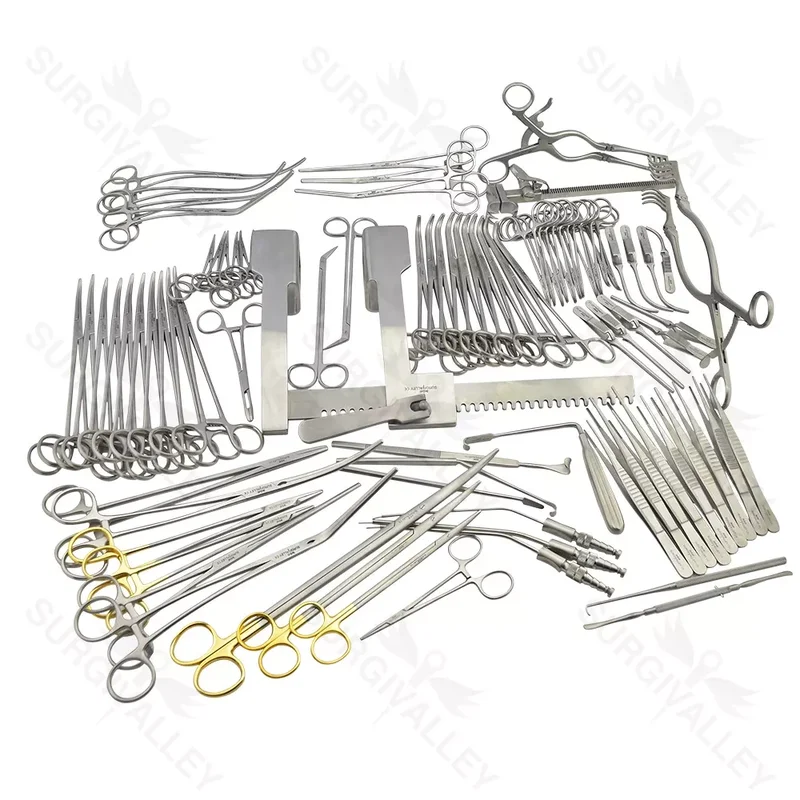
- Recommended Cardiovascular and Thoracic Set BOM
- Manufacturing, Quality Control, and Inspection Checkpoints in Sialkot
- CSSD Sterilization Cassette Engineering
- Buyer RFQ and Ordering Checklist
- Procurement Path with Precision Kit World
Executive Overview and B2B Procurement Context
Cardiovascular and thoracic procedures require instrument sets engineered for atraumatic tissue handling, controlled vascular occlusion, reliable fine-suture manipulation, and repeatable CSSD processing. For hospital procurement teams, the difference between a nominally complete tray and a clinically engineered set is found in jaw geometry, occlusion force, articulation, surface finish, dimensional control, traceability, and reconciliation of every bill-of-materials line.
Precision Kit World manufactures complete cardiovascular, vascular, and thoracic surgical instrument sets and sterilization-ready procedural trays in Sialkot, Pakistan. This guide defines a practical engineering specification for DeBakey and Cooley atraumatic instruments, Satinsky vena cava clamps, Bulldog cross-clamps, Potts-Smith arteriotomy scissors, Castroviejo micro needle holders, and Finochietto or Burford rib-spreading systems.
The specification is intended for hospital procurement directors, CSSD managers, Ministry of Health tender boards, distributors, and OEM private-label buyers. It supports like-for-like quotation comparison, sample approval, technical file review, instrument-count reconciliation, and long-term replacement planning.
- Clinical risk control: longitudinal atraumatic serrations, controlled clamp pressure, smooth box locks, and correctly aligned blades reduce the risk of intimal trauma, slippage, suture damage, and uncontrolled cutting.
- Procurement control: a line-by-line BOM establishes exact quantities, working lengths, patterns, finishes, and accessory requirements before quotation.
- CSSD control: validated instrument cassettes, open positions, drainage paths, and material compatibility support cleaning, inspection, sterilization, and storage.
- Commercial control: documented inspection criteria reduce disputes concerning substitutions, missing pieces, dimensional variation, and inconsistent private-label production.
Clinical Engineering Scope
DeBakey and Cooley Atraumatic Jaw Geometry
DeBakey and Cooley patterns should not be treated as generic serrated forceps. The working surface must be precision-milled or precision-formed to create continuous longitudinal tissue-contact geometry rather than irregular stamped teeth. The objective is secure handling of vascular adventitia and other delicate tissue while minimizing concentrated point loading on the intima.
The recommended DeBakey pattern uses a 1x2 longitudinal serration configuration, while the Cooley pattern uses a 2x3 longitudinal serration configuration. These designations must be confirmed on the approved drawing because market terminology is not fully standardized across manufacturers. The serrations should run longitudinally along the working face, terminate cleanly before the jaw tip, and remain free of burrs, rolled metal, or transverse cutting edges.
- Recommended jaw-tip mismatch at closure: no more than 0.05 mm for standard vascular forceps and no more than 0.03 mm for microvascular patterns.
- Recommended serration height variation within one instrument: maximum 0.03 mm.
- Recommended jaw-face parallelism over the primary contact zone: maximum 0.05 mm deviation for standard patterns.
- Recommended tip alignment under a 10 N closing load: maximum lateral offset of 0.10 mm.
- Recommended atraumatic surface roughness: Ra 0.20 to 0.40 micrometres on the contact face, with no sharp burrs or raised defects.
Manufacturers should verify the jaw profile under calibrated optical magnification or a vision-measuring system. A tactile inspection alone is insufficient for distinguishing a controlled 1x2 or 2x3 longitudinal profile from an inconsistent stamped serration.
Satinsky Vena Cava Clamps
Satinsky clamps require asymmetric, angled jaw geometry that permits partial or side-biting occlusion of the vena cava or other large vessels while maintaining access to the operative field. The jaw curvature, hinge alignment, ratchet engagement, and atraumatic longitudinal serrations must work together. Excessive tip pressure, uneven closure, or a sharp jaw transition can create localized vessel injury.
Each Satinsky pattern should be defined by overall length, jaw length, jaw angle, maximum opening, curvature, ratchet positions, and the intended partial-occlusion application. The approved drawing should specify whether the device is straight, angled, curved, or offset and whether the clamp is supplied with a standard or extra-long handle.
- Jaw closure should be continuous from heel to tip without visible daylight at the controlled contact area when tested without excessive hand force.
- Ratchet teeth should engage positively at every specified locking position and release without binding.
- Tip alignment should be checked at the first, middle, and final ratchet positions.
- At least three production samples per lot should undergo functional opening, closure, and release cycling.
- Contact surfaces should be passivated and free from grinding marks that run transversely across the vessel-contact direction.
Bulldog Cross-Clamps and Calibrated Spring Occlusion Pressure
Bulldog clamps use spring force to produce temporary vascular occlusion. The spring must provide repeatable closing pressure without excessive force that could compromise the vessel wall. Because clamp pressure changes with jaw geometry, opening distance, spring condition, and contact-pad design, the pressure specification must be stated as a measured force in grams at a defined jaw opening and measurement location.
A practical purchase specification should identify the nominal occlusion force, tolerance, jaw length, jaw opening, spring material, and whether the force is measured at the tip or at the mid-jaw. As an example, Precision Kit World may engineer a standard Bulldog family at 80 to 140 gf measured at the distal jaw contact point with a 3.0 mm jaw opening, subject to the approved product drawing and clinical application. Microvascular variants may require a lower range, such as 40 to 80 gf at a 2.0 mm opening.
- Force measurement equipment should have a resolution of at least 1 gf and calibration traceable to a recognized national or international standard.
- Force should be recorded at a defined opening, not merely as a free-state spring measurement.
- Lot acceptance should include minimum, maximum, and mean force values for sampled instruments.
- Spring return should be verified after repeated opening cycles, with no permanent set that moves the result outside the approved tolerance.
- Jaw tips should meet without lateral offset, and the contact face should not contain a sharp edge or point defect.
Potts-Smith Arteriotomy Scissors
Potts-Smith scissors are specified by the angle between the blade axis and the handle axis. Common procurement configurations include 25°, 45°, and 60°. The quotation must state whether the angle is measured from the handle centerline, the blade centerline, or the plane of the cutting edge. Ambiguous angle descriptions frequently produce non-equivalent instruments.
For vascular arteriotomy work, the tips should be fine, smoothly finished, and capable of initiating a controlled cut without catching. The blades should meet from proximal to distal cutting zone, with no visible daylight at the primary cutting region. A practical production specification may require a blade-angle tolerance of ±2°, tip-radius control within the approved drawing, and a cutting test on standardized synthetic vascular tubing or equivalent test media.
- 25°: useful where a relatively shallow approach and controlled longitudinal extension are required.
- 45°: a general-purpose angled arteriotomy configuration for many vascular approaches.
- 60°: useful where access geometry requires a more pronounced offset from the handle axis.
- Scissor action should remain smooth through the full opening and closing cycle without lateral blade deflection.
- Edges must cut the specified test medium without tearing, snagging, or excessive deformation.
Castroviejo Micro Needle Holders
Castroviejo micro needle holders are commonly used for fine vascular anastomoses involving 6-0 and 7-0 Prolene or comparable monofilament sutures. The critical parameters are jaw width, jaw length, tip alignment, spring action, handle balance, locking or non-locking configuration, and surface texture. Serrations that are too aggressive may damage fine needles or suture material; a surface that is too smooth may permit rotation during knot placement.
For 6-0 and 7-0 work, the approved design should specify whether the jaws are smooth, longitudinally serrated, cross-serrated, tungsten-carbide faced, or diamond-textured. Tip closure should be verified under magnification, and the instrument should hold a representative microsurgical needle without unintended rotation under a defined manual load.
- Recommended tip alignment: maximum 0.03 mm offset for micro patterns.
- Recommended jaw parallelism: maximum 0.04 mm over the primary gripping zone.
- Spring return should be uniform, without a sudden catch or uncontrolled snap.
- Jaw faces should not contain raised burrs capable of scoring a needle or cutting monofilament.
- The engineering drawing should identify 6-0, 7-0, or combined-use suitability rather than using only the term “micro.”
Finochietto and Burford Rib Spreaders
Finochietto and Burford rib spreaders are load-bearing thoracic instruments. The frame, rack, pinion, ratchet, handle, blade seats, and interchangeable blades must be treated as a mechanical system. A rib spreader that opens smoothly without load but slips under retraction force is not acceptable for institutional use.
The specification should include maximum opening, frame span, rack pitch, blade width, blade depth, blade angle, interchangeable-blade interface, and load test. Blades should be available in multiple profiles where the procedure requires different rib contact geometry. The blade seat must resist rocking, unintentional rotation, and release during use.
- Rack and pinion teeth should engage fully across the specified working range without skipping.
- Under the approved proof load, permanent deformation should remain within the drawing limit; a typical internal criterion is no visible deformation and no functional change after 500 N proof loading, subject to model size and clinical validation.
- Interchangeable blades should be uniquely identified by size or profile and should fit the mating frame without forced assembly.
- Contact edges should be rounded or profiled according to the approved drawing, with no exposed burrs.
- After load cycling, the spreader must open, close, lock, and release normally.
Materials, Metallurgy, and Surface Engineering
Reusable cardiovascular and thoracic instruments should be manufactured from corrosion-resistant surgical stainless steel selected according to the mechanical demand of each component. Austenitic stainless steels such as AISI 316L are appropriate for many forceps, scissors, and clamps where corrosion resistance and toughness are primary requirements. Martensitic stainless steels such as AISI 420 or 440A may be appropriate for cutting edges or high-wear components when heat treatment is tightly controlled. The exact grade, heat-treatment condition, and component application should be listed in the technical file and purchasing specification.
Material selection should be supported by mill certification or equivalent material traceability. A practical incoming acceptance package may include chemical composition verification by X-ray fluorescence, hardness testing, visual surface inspection, and review of heat-treatment records. For hardened cutting or load-bearing parts, hardness should be specified by component rather than assumed from the steel designation.
- Typical 316L working components: hardness approximately 180 to 240 HV, unless the approved design requires another condition.
- Typical martensitic cutting components: approximately 45 to 55 HRC after validated heat treatment, subject to blade geometry and the approved drawing.
- Material identification: positive material identification or certificate review for each incoming heat or batch.
- Passivation: nitric or citric passivation process validated against the applicable internal procedure and corrosion-resistance requirement.
- Surface finish: electropolished or mechanically polished surfaces should be continuous, cleanable, and free from embedded abrasive particles.
Applicable reference frameworks may include ASTM F899 for stainless steels used in surgical instruments, ISO 7153-1 for materials used in surgical instruments, ASTM A967 for chemical passivation, ISO 13485 for the quality-management system, ISO 14971 for risk management, ISO 15223-1 for applicable labeling symbols, and ISO 17665 for moist-heat sterilization process validation. These references should be applied according to the product classification, destination-market requirements, and validated manufacturing process.
Technical Comparison and Specification Table
| Instrument or component | Primary geometry | Recommended numeric control | Functional verification | Procurement decision point |
|---|---|---|---|---|
| DeBakey atraumatic forceps | 1x2 longitudinal serrations; fine or standard vascular tip | Tip offset ≤0.10 mm; jaw mismatch ≤0.05 mm; contact-face Ra 0.20–0.40 µm | Optical serration inspection; closure alignment; burr and edge inspection | Confirm pattern, length, tip width, and whether serrations are milled or formed |
| Cooley atraumatic forceps | 2x3 longitudinal serrations; vascular or angled pattern | Micro-tip offset ≤0.03 mm where specified; serration variation ≤0.03 mm | Vision measurement; controlled closure test; magnified tip inspection | Confirm 2x3 pattern, jaw curvature, and intended vessel size |
| Satinsky vena cava clamp | Angled, side-biting, atraumatic jaws with ratchet | Jaw angle and opening per drawing; tip alignment ≤0.10 mm | Ratchet cycling; heel-to-tip closure; opening and release test | Specify partial-occlusion geometry, overall length, jaw length, and angle |
| Bulldog cross-clamp | Spring-loaded atraumatic jaws | Standard example: 80–140 gf at 3.0 mm opening; micro example: 40–80 gf at 2.0 mm | Calibrated force-gauge test; spring-return and cycling test | State grams, opening distance, measurement point, and tolerance |
| Potts-Smith scissors | Angled blades at 25°, 45°, or 60° | Angle tolerance typically ±2°; tip and blade closure per drawing | Angle measurement; standardized tubing cut; edge and tip inspection | Define angle datum, length, tip style, and right- or left-hand configuration |
| Castroviejo needle holder | Micro spring or locking handle; fine gripping jaws | Tip offset ≤0.03 mm; jaw parallelism ≤0.04 mm | 6-0 and 7-0 representative needle holding; spring-cycle test | Specify suture range, jaw texture, length, and locking preference |
| Finochietto or Burford spreader | Rack-and-pinion frame with interchangeable blades | Example proof load 500 N; no functional change after load cycle | Load, rack engagement, blade retention, and dimensional inspection | Specify maximum opening, blade profiles, frame size, and spare blades |
Recommended Cardiovascular and Thoracic Set BOM
The following is an engineering reference BOM for a combined cardiovascular and thoracic procedural set. It is not a universal clinical preference. Final quantities should be approved by the operating service, CSSD, and procurement authority. Every line should carry a unique item code, revision level, quantity, and replacement status.
| Line | Instrument description | Pattern or specification | Recommended quantity | Piece-count control |
|---|---|---|---|---|
| 1 | Dissecting forceps | DeBakey 1x2, 200 mm, atraumatic | 2 | Verify two identical pieces |
| 2 | Dissecting forceps | Cooley 2x3, 240 mm, angled | 2 | Verify pattern and working length |
| 3 | Vascular clamp | Satinsky, 230 mm, side-biting, angled | 2 | Confirm left/right or universal configuration |
| 4 | Vascular clamp | Satinsky, 280 mm, long pattern | 1 | Do not substitute standard length |
| 5 | Cross-clamp | Bulldog, standard, 80–140 gf at 3.0 mm | 4 | Record force range and test method |
| 6 | Cross-clamp | Bulldog, micro, 40–80 gf at 2.0 mm | 2 | Separate from standard Bulldog count |
| 7 | Arteriotomy scissors | Potts-Smith, 25°, 180 mm | 1 | Angle and length must match BOM |
| 8 | Arteriotomy scissors | Potts-Smith, 45°, 180 mm | 1 | Angle and length must match BOM |
| 9 | Arteriotomy scissors | Potts-Smith, 60°, 180 mm | 1 | Angle and length must match BOM |
| 10 | Micro needle holder | Castroviejo, 6-0/7-0 compatible, 180 mm | 2 | Confirm jaw texture and spring type |
| 11 | Rib spreader | Finochietto or Burford, adult frame | 1 | Frame and blade system counted together |
| 12 | Interchangeable spreader blades | Adult, narrow and standard profiles | 2 pairs | Count each blade individually and label profile |
| 13 | Vascular forceps | DeBakey angled, 250 mm | 2 | Verify two-piece quantity |
| 14 | Instrument cassette | Perforated stainless-steel sterilization cassette with lid and silicone retainers | 1 | Confirm cassette internal dimensions and usable capacity |
The reference BOM contains 24 individual instruments or blade components when the two pairs of interchangeable blades are counted as four separate blades, plus one sterilization cassette. The final commercial BOM must state whether the cassette is included in the instrument piece count, packaged as a separate line, or billed as a tray accessory. This distinction prevents discrepancies between the packing list, invoice, CSSD inventory, and tender evaluation sheet.
Manufacturing, Quality Control, and Inspection Checkpoints in Sialkot
Incoming Material and Component Control
- Review material certificates against purchase order, heat number, grade, and component application.
- Perform positive material identification or documented certificate verification on sampled incoming material.
- Inspect sheet, bar, wire, spring, and blade stock for corrosion, laminations, deep scratches, and dimensional nonconformity.
- Assign batch traceability before cutting, forging, machining, stamping, or heat treatment.
Machining, Forming, and Serration Inspection
- Inspect CNC-machined jaw profiles against the released drawing before assembly.
- Use calibrated optical measurement for DeBakey 1x2 and Cooley 2x3 longitudinal serrations.
- Check jaw length, width, curvature, tip thickness, and hinge-hole location with calibrated gauges.
- Verify Potts-Smith angles at 25°, 45°, and 60° using an angle-measuring fixture with a defined datum.
- Inspect Castroviejo tips at magnification for closure, alignment, burrs, and surface damage.
Heat Treatment, Passivation, and Finishing
- Record furnace identification, cycle parameters, load number, and component batch for hardened parts.
- Verify hardness at the designated test location without compromising the working surface.
- Apply a controlled passivation process and inspect for discoloration, etching, residues, and water-break behavior.
- Measure representative surface roughness where the drawing identifies a critical contact or cleanability surface.
- Reject instruments with embedded abrasive, sharp burrs, grinding cracks, or transverse scoring across atraumatic jaw faces.
Functional and Durability Verification
- Measure Bulldog occlusion force in grams using a calibrated force gauge at the specified jaw opening.
- Cycle ratchets, box locks, spring handles, and rack-and-pinion assemblies using a documented internal test method.
- Test Satinsky clamps for smooth opening, positive ratchet engagement, closure alignment, and release.
- Test Potts-Smith scissors on standardized synthetic tubing or approved equivalent medium for clean cutting and tip initiation.
- Test Castroviejo holders with representative 6-0 and 7-0 needle sizes for grip, alignment, and controlled release.
- Proof-test rib spreaders according to the approved load rating and inspect for permanent deformation, rack skipping, or blade-seat movement.
Final Inspection and Piece-Count Reconciliation
Final inspection should combine visual examination, functional testing, dimensional sampling, labeling review, and a 100% BOM reconciliation. The inspector should scan or record each item code, description, size, pattern, and quantity. Instruments with similar appearance but different jaw lengths, angles, or force classes should be separated into individually labeled positions.
For export or institutional supply, Precision Kit World can prepare a controlled packing list, certificate of conformity, material documentation where specified, inspection report, sterilization-cassette drawing, and replacement-item matrix. Acceptance sampling may be structured using ISO 2859-1 principles, but critical characteristics such as missing instruments, wrong pattern, failed locking function, exposed burrs, or incorrect Bulldog force should be treated according to the purchaser’s zero-acceptance or tightened inspection policy.
CSSD Sterilization Cassette Engineering
A cardiovascular or thoracic set should be supplied in a cassette designed for cleaning access, visual inspection, instrument protection, and validated sterilization. The cassette should not compress atraumatic jaw faces, fine scissor tips, or Castroviejo jaws. Silicone or polymer retainers must be compatible with the intended sterilization cycle and must not obstruct drainage or steam contact.
- Use perforated stainless steel with rounded, cleanable edges and no crevices that retain soil.
- Provide dedicated retention positions for Satinsky clamps, Bulldogs, fine scissors, and micro needle holders.
- Keep delicate jaws open or positioned according to the manufacturer’s validated cleaning and sterilization instructions.
- Prevent metal-to-metal impact between rib-spreader components and micro instruments.
- Identify the cassette with set name, set code, revision, tray number, and maximum validated load where applicable.
- Define the cassette’s external dimensions, internal usable dimensions, tare weight, loaded weight, and lid-locking method.
CSSD validation should address point-of-use handling, manual or automated cleaning, inspection under magnification where required, packaging configuration, sterilization cycle, drying, and storage. Moist-heat sterilization parameters must be validated for the actual load and packaging configuration; a generic cycle statement is not a substitute for site-specific validation.
Buyer RFQ and Ordering Checklist
Product Definition
- State the procedure name, service line, intended patient population, and expected annual procedure volume.
- Provide the complete BOM with item codes, quantities, dimensions, patterns, and acceptable alternatives.
- Specify whether the requirement is a complete set, replacement instruments, a procedural tray, or a CSSD cassette-only project.
- Identify required private-label markings, laser codes, language, packaging, and regulatory-market documentation.
Technical Parameters
- For DeBakey forceps, specify 1x2 longitudinal serrations, working length, tip width, jaw curvature, and surface finish.
- For Cooley forceps, specify 2x3 longitudinal serrations, angled or straight pattern, and tip alignment tolerance.
- For Satinsky clamps, specify jaw angle, jaw length, overall length, side-biting profile, ratchet positions, and intended vessel application.
- For Bulldogs, specify occlusion force in grams, measurement point, jaw opening, tolerance, and force-test report requirements.
- For Potts-Smith scissors, specify 25°, 45°, or 60°, angle datum, right- or left-hand configuration, blade length, and tip form.
- For Castroviejo holders, specify 6-0, 7-0, or combined compatibility, jaw texture, spring or locking handle, and jaw length.
- For Finochietto or Burford spreaders, specify frame size, maximum opening, blade profiles, proof load, and number of spare blades.
- Specify material grades, heat-treatment requirements, passivation, finish, hardness, and corrosion-resistance documentation.
Quality, Documentation, and Logistics
- Request a controlled technical drawing or dimensional data sheet for every critical instrument family.
- Request a pre-production sample or first-article approval before bulk manufacture.
- Require a line-by-line inspection report with actual or sampled measurements for critical characteristics.
- Confirm the applicable quality system, traceability method, nonconformance process, and change-control procedure.
- Define acceptable packaging, cassette design, sterilization compatibility, carton labeling, and pallet configuration.
- Agree on replacement availability, spare-blade supply, service life expectations, warranty terms, and complaint-response timelines.
- Reconcile the final packed quantity against the approved BOM before shipment and again at hospital receipt.
Procurement Path with Precision Kit World
For a technically controlled quotation, submit the procedure name, target market, complete BOM, required instrument drawings or reference samples, annual volume, branding requirements, CSSD cassette preference, and delivery destination. Precision Kit World can then prepare a structured proposal covering instrument specifications, material options, quality documentation, sample approval, manufacturing lead time, packaging, and piece-count reconciliation.
Review complete surgical instrument sets, explore configurable surgical sets, and learn about Precision Kit World manufacturing and quality capabilities. Distributors may review the distributor program. For a cardiovascular, thoracic, vascular, or CSSD cassette RFQ, contact the engineering and commercial team through Precision Kit World.
Related Categories & Sourcing Hubs
Ayesha Siddiqa
Lead Operating Theatre Nurse & Delivery Tray Manager
Reviewed against DIN sterilization basket standards, itemized surgical set BOMs, and operating theatre turnaround protocols.