 English


Cesarean Section & OB/GYN Delivery Sets: Standard Maternal Tray Setup
Standardized C-section and obstetric delivery instrument tray configurations designed for rapid procedural response and maternal care.

Reviewed against DIN sterilization basket standards, itemized surgical set BOMs, and operating theatre turnaround protocols.
On this page (10)
- Executive Overview and B2B Procurement Context
- Standardized Maternal Tray Architecture
- PPH Readiness and Emergency Clamp Configuration
- Material, Metallurgical, and Surface Engineering
- Cesarean Section and Delivery Set Comparison
- Manufacturing, Quality Control, and Inspection Checkpoints in Sialkot
- CSSD Sterilization Cassette and Tray Engineering
- Buyer RFQ and Ordering Checklist
- Standardization, Traceability, and Distributor Supply
- Conclusion and Procurement Action
Executive Overview and B2B Procurement Context
Precision Kit World manufactures standardized Cesarean Section and OB/GYN delivery instrument sets for hospitals, Ministry of Health tenders, distributors, and centralized sterile processing departments. A controlled maternal tray configuration reduces operating-room delays, prevents missing-instrument substitutions, improves count reconciliation, and gives CSSD teams a repeatable inspection, cleaning, sterilization, and traceability workflow.
This specification separates the higher-volume Cesarean Section set, typically configured at 50–65 pieces, from the compact Normal Episiotomy/Delivery Kit, typically configured at 12–18 pieces. The specification also identifies a defined postpartum hemorrhage (PPH) readiness pathway. PPH-critical clamps and uterine hemostasis instruments must not be assumed to be available merely because a general delivery tray is present.
For commercial procurement, the purchase order should define the exact bill of materials (BOM), piece count, working length, jaw geometry, ratchet pattern, surface finish, sterilization method, cassette layout, labeling, and acceptance criteria. The phrase “standard C-section set” is not sufficiently precise for a tender, distributor quotation, or hospital validation sample.
Explore the complete surgical instrument sets portfolio, review available surgical sets, assess Precision Kit World manufacturing capabilities, or request a quotation through the contact page.
Standardized Maternal Tray Architecture
Cesarean Section Set: Target Configuration of 60 Pieces
The following configuration is a recommended baseline. Hospitals may add or remove instruments according to surgeon preference, clinical protocol, and national tender requirements. The recommended production target is 60 pieces, within the requested 50–65-piece range.
| Group | Instrument | Recommended quantity | Primary function | Configuration requirement |
|---|---|---|---|---|
| Scalpel and dissection | Scalpel handle No. 3 | 1 | Skin and fascial incision | Compatible with No. 10, 11, 12 and 15 blades |
| Scalpel and dissection | Scalpel handle No. 4 | 1 | Extended incision work | Compatible with No. 20–25 blades |
| Scalpel and dissection | Metzenbaum scissors, curved, 18 cm | 1 | Fine soft-tissue dissection | Rounded or blunt tips; smooth opening and closing |
| Scalpel and dissection | Mayo scissors, curved, 17 cm | 1 | Dense tissue and suture cutting | Heavy pattern, controlled cutting through full stroke |
| Scalpel and dissection | Mayo scissors, straight, 14–17 cm | 1 | Suture and material cutting | Sharp or sharp/blunt pattern as specified by the hospital |
| Hemostasis | Mosquito artery forceps, curved | 6 | Small-vessel control | Fine serrations; atraumatic tip alignment |
| Hemostasis | Kelly artery forceps, curved | 6 | Medium-vessel control | Half-serrated jaw pattern unless otherwise specified |
| Hemostasis | Crile artery forceps, straight | 4 | General hemostasis | Full serration and positive ratchet engagement |
| Hemostasis | Kocher/Ochsner forceps, straight, 1 x 2 teeth | 2 | Grasping fascia and dense tissue | Sharp tooth definition without burrs |
| Hemostasis | Green-Armytage uterine hemostasis clamp, 24–25 cm | 8 | Uterine incision edge and uterine hemostasis control | Eight pieces per tray; broad atraumatic working face; matched jaw closure |
| Hemostasis | Babcock tissue forceps, atraumatic, 20–24 cm | 2 | Uterine or soft-tissue handling | Fenestrated, atraumatic jaws |
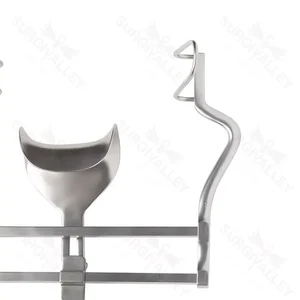
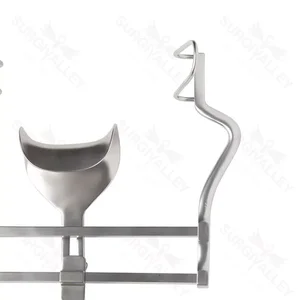
| Retractors | Fritsch/Doyen broad suprapubic bladder retractor | 1 | Bladder and suprapubic exposure | Broad, smooth blade; no sharp perimeter corners |
| Retractors | Deaver retractor, 25–32 cm | 2 | Deep abdominal exposure | Broad blade with rounded edges |
| Retractors | Richardson retractor, small or medium | 2 | Fascial and abdominal wall retraction | Size to be nominated on purchase order |
| Retractors | Army-Navy retractor | 2 | Superficial wound retraction | Double-ended, smooth non-cutting margins |
| Grasping and tissue handling | Foerster sponge forceps, straight | 2 | Sponge holding and tissue preparation | Fenestrated ring jaws; secure ratchet |
| Grasping and tissue handling | Pennington tissue forceps | 2 | Secure atraumatic tissue handling | Triangular jaw profile; controlled tooth engagement |
| Grasping and tissue handling | Allis tissue forceps, 4 x 5 teeth | 2 | Fascial and tissue-edge grasping | Symmetrical teeth; no overbite in closed position |
| Grasping and tissue handling | Dissecting forceps, 1 x 2 teeth, 15–20 cm | 2 | General tissue handling | Fine, aligned tips |
| Grasping and tissue handling | Adson forceps, toothed | 2 | Skin and fascia handling | Fine teeth with rounded external edges |
| Grasping and tissue handling | Adson forceps, non-toothed | 2 | Delicate tissue handling | Fine serration or plain atraumatic tips as specified |
| Needle holders | Mayo-Hegar needle holder, 16–18 cm | 2 | General suturing | Cross-serrated jaws; no jaw rocking |
| Needle holders | Heaney needle holder, curved, 20–24 cm | 2 | Deep pelvic suturing | Curved profile and secure needle capture |
| Needle holders | Long needle holder, 24–26 cm | 1 | Deep-field suturing | Length and jaw pattern to be confirmed by surgeon |
| Umbilical and cord instruments | Umbilical cord scissors, blunt/blunt, 16–18 cm | 1 | Umbilical cord division | Rounded tips; smooth full-length cutting action |
| Umbilical and cord instruments | Umbilical cord clamps | 2 | Temporary cord occlusion | Reusable or single-use specification to be stated in RFQ |
| Suction and auxiliary instruments | Yankauer suction tube, reusable | 1 | Operative suction | Reusable stainless steel or polymer specification to be nominated |
| Suction and auxiliary instruments | Gigli saw with handles | 1 set | Specialized bone-cutting contingency | Include only where hospital protocol requires it |
| Count and support | Instrument marking or identification tags | As required | Tray-level traceability | Laser marking or etched code without flaking coating |
The listed baseline contains 60 functional pieces when the Gigli saw is treated as one saw with two integrated handles and the cord clamps are counted individually. If the hospital excludes the Gigli saw or reusable suction component, the set remains configurable within the 50–65-piece range. Precision Kit World should issue a controlled final BOM showing every individual piece and the exact reconciliation formula before production release.
Normal Episiotomy and Delivery Kit: Target Configuration of 16 Pieces
| Group | Instrument | Quantity | Clinical use | Procurement note |
|---|---|---|---|---|
| Scissors | Episiotomy scissors, angled or curved, 14–16 cm | 1 | Episiotomy incision | Specify left- or right-handed pattern if applicable |
| Scissors | Umbilical cord scissors, blunt/blunt | 1 | Cord division | Rounded tips and smooth cutting action |
| Hemostasis | Mosquito artery forceps, curved | 4 | Small-vessel control | Fine serrated jaws and functional ratchets |
| Hemostasis | Kelly artery forceps, straight or curved | 2 | General hemostasis | Pattern to be nominated on RFQ |
| Grasping | Foerster sponge forceps, straight | 2 | Sponge and swab handling | Fenestrated ring jaws |
| Grasping | Allis tissue forceps | 2 | Tissue-edge control | Tooth pattern to be specified |
| Grasping | Dissecting forceps, toothed | 1 | General tissue handling | Fine aligned tips |
| Needle holding | Mayo-Hegar needle holder, 16–18 cm | 1 | Repair suturing | Cross-serrated jaw insert or integral serration |
| Retracting | Small vaginal or perineal retractor | 1 | Local exposure | Pattern to be approved by clinical user |
| Cord management | Umbilical cord clamps | 2 | Cord occlusion | Reusable or disposable status must be declared |
The delivery kit totals 16 pieces. It is not a substitute for the Cesarean Section set and should not be represented as containing uterine hemostasis clamps, a broad suprapubic bladder retractor, deep pelvic needle holders, or a complete PPH response configuration.
PPH Readiness and Emergency Clamp Configuration
Every maternity service should define whether emergency PPH instruments are stored as a dedicated supplementary pack, a second sealed cassette, or a clearly identified compartment in the maternal tray. PPH readiness should be verified at case-opening and during emergency cart checks rather than inferred from the presence of a standard delivery kit.
- Green-Armytage uterine hemostasis clamps: Include 6–8 pieces in every Cesarean Section tray; this specification uses 8 pieces to support bilateral uterine-incision control and replacement availability.
- Emergency PPH reserve: Consider a separately sealed reserve of 2 additional Green-Armytage clamps, subject to the hospital’s clinical protocol and count policy.
- Broad exposure: The Fritsch/Doyen broad suprapubic bladder retractor must be immediately identifiable and positioned for rapid access.
- Sponge control: Pennington and Foerster sponge forceps should be present in sufficient quantity to support tissue handling and swab management without substituting general-purpose clamps.
- Long-reach suturing: Heaney and long needle holders should be included where the clinical service requires deep pelvic access.
- Tray identification: The label should state “Cesarean Section and PPH-Ready Configuration” only when the agreed PPH reserve and instrument list are physically present.
PPH instrument availability does not replace clinical hemorrhage protocols, medications, blood-product readiness, balloon systems, or surgical decision-making. The tray specification controls instrument availability and count integrity only.
Material, Metallurgical, and Surface Engineering
Stainless Steel Selection
Reusable surgical instruments should be manufactured from corrosion-resistant stainless steel selected according to instrument function. Austenitic stainless steels such as AISI 304 or AISI 316L may be appropriate for selected non-load-bearing components, while martensitic stainless steels such as AISI 410, 420, or equivalent surgical grades are commonly used for cutting edges, grasping jaws, ratchets, and wear-resistant working parts. The final grade must be stated in the device master record and verified through material certificates or an agreed test method.
| Engineering characteristic | Recommended control parameter | Acceptance target | Verification method | Procurement implication |
|---|---|---|---|---|
| Material identity | Declared stainless-steel grade by component | Grade matches approved drawing and material certificate | Mill certificate review and PMI/XRF sampling where required | Prevents unapproved substitution between 304, 316L, 410, and 420 grades |
| Passive surface | Free iron and heat-tint control | No visible scale, rust bloom, embedded ferrous contamination, or blue heat discoloration | Visual inspection, cleaning validation, and optional ferroxyl testing | Important for repeated steam sterilization and chloride exposure |
| Surface roughness | Working and external surfaces | Typical target Ra ≤ 0.8 µm for polished external surfaces; serrated jaws and teeth excluded from this numerical target | Profilometer sampling or validated comparator | Lower roughness supports cleanability and limits soil retention |
| Dimensional tolerance | Overall length and critical jaw geometry | Generally ±0.50 mm for instruments up to 200 mm; ±1.00 mm for instruments above 200 mm, unless drawing states tighter control | Caliper, height gauge, optical comparator, and approved gauges | Exact tolerances must be frozen on the approved drawing |
| Jaw alignment | Closed-jaw tip and edge alignment | Typical maximum visible lateral mismatch 0.20 mm for fine forceps and 0.30 mm for heavy forceps, unless product drawing states otherwise | Optical inspection and calibrated feeler gauges | Controls tissue trauma and incomplete clamping |
| Ratchet function | First-tooth engagement and release | Positive engagement on every tooth; no accidental release under normal manual load; release without binding | Functional inspection and sample force testing | Critical for Green-Armytage, artery, sponge, and needle-holder patterns |
| Cutting performance | Scissors and cord scissors | Continuous clean cut through specified test medium across the working length without snagging or crushing | Product-specific cut test and visual edge inspection | Test medium and acceptance criteria must be agreed before approval |
| Steam-cycle durability | Reusable instrument exposure | No functional deterioration, visible corrosion, flaking, cracking, or ratchet failure after agreed repeated cycles | Validation protocol using representative instruments | Cycle count, load configuration, detergent, and water quality must be documented |
| Bioburden and cleaning compatibility | Reusable device design | Surfaces and joints accessible to the validated cleaning process | Cleaning validation and visual or analytical residue testing | Supports the hospital’s ISO 17664-based reprocessing instructions |
ASTM F899 may be used as a reference for stainless steels for surgical instruments, while ISO 7153-1 provides a recognized framework for materials used in surgical instruments. These references do not eliminate the need for an approved product drawing, material declaration, risk assessment, and clinical-user acceptance. Exact chemistry, hardness, edge geometry, and heat treatment should be controlled by the instrument family rather than copied indiscriminately across all instruments.
Heat Treatment and Mechanical Performance
- Martensitic instruments: Cutting and grasping instruments should receive controlled hardening and tempering appropriate to their design. A typical engineering target may be approximately 40–48 HRC for durable forceps and ratchet components, while cutting components may require a different hardness range defined by the approved drawing.
- Hardness verification: Use calibrated Rockwell testing on representative coupons or non-functional sample pieces where direct testing could damage the finished instrument.
- Elasticity: Fine forceps and spring-style instruments should return to their specified neutral geometry after repeated opening cycles without permanent set.
- Joint construction: Box locks, pivot joints, and assembled ratchets should be free of excessive play. Riveted or screwed joints must withstand repeated manual cycling without loosening.
- Galvanic control: Dissimilar metals should not be combined without a documented compatibility assessment, particularly in ratchet inserts, marking components, and cassette contact points.
Textile, Sponge, and Cassette Interface Considerations
Foerster and sponge-forceps configurations must be compatible with the hospital’s approved swab dimensions and count policy. If the tray is supplied with textile accessories, the purchase order must state whether the textiles are reusable or disposable, the fiber composition, lint limits, radiopacity requirement, absorbency specification, and laundering or sterilization pathway. Instrument sets should not be credited with textile pieces unless those items are physically supplied and included in the controlled BOM.
For CSSD use, the tray should provide separation between heavy retractors, delicate forceps, sharp scissors, and ratcheted instruments. Silicone holders or polymer retainers must be steam-compatible, securely retained, and free from cracking after the validated sterilization cycle. The cassette shall not obstruct steam penetration, condensate drainage, or visual inspection of instrument jaws and box locks.
Cesarean Section and Delivery Set Comparison
| Specification | Cesarean Section set | Normal Episiotomy/Delivery Kit | PPH readiness expectation | CSSD and procurement control |
|---|---|---|---|---|
| Nominal piece count | 50–65 pieces; recommended baseline 60 | 12–18 pieces; recommended baseline 16 | Supplementary reserve may be separate | Count every individual instrument and accessory |
| Green-Armytage clamps | 6–8 pieces; recommended 8 | Not normally included in the compact kit | Two additional reserve clamps may be sealed separately | State length, jaw width, ratchet teeth, and quantity |
| Bladder retraction | Fritsch/Doyen broad suprapubic retractor included | Not normally included | Must be rapidly identifiable for emergency access | Record blade width, depth, radius, and overall length |
| Sponge forceps | Foerster, typically 2 pieces | Foerster, typically 2 pieces | Additional quantity only by protocol | Specify straight or curved, ring diameter, and serration |
| Pennington forceps | Typically 2 pieces | Optional depending on delivery protocol | Should not be substituted with Allis forceps without approval | Specify triangular jaw dimensions and atraumatic profile |
| Umbilical cord scissors | 1 piece | 1 piece | Maintain a sterile backup where emergency policy requires | Specify blunt/blunt tips and working length |
| Deep pelvic access | Heaney and long needle holders; Deaver and Richardson retractors | Limited or absent | Required only when included in the emergency surgical pathway | Validate tray weight, layout, and safe retrieval |
| Typical use | Abdominal delivery, uterine closure, deep-field exposure, and hemostasis | Perineal repair, cord management, and routine delivery support | Rapid escalation support, not a substitute for clinical protocol | Use separate catalog numbers for each configuration |
Manufacturing, Quality Control, and Inspection Checkpoints in Sialkot
Incoming Material and Component Control
- Review supplier material certificates against the approved stainless-steel grade and heat or lot number.
- Inspect bar, sheet, tube, and forged blanks for laminations, deep scratches, scale, inclusions, and dimensional deviation.
- Maintain lot traceability from raw material receipt through forging, machining, heat treatment, polishing, assembly, inspection, and packing.
- Segregate nonconforming material and prevent accidental mixing of visually similar stainless-steel grades.
In-Process Manufacturing Controls
- Verify critical dimensions after forging and machining, including overall length, jaw width, blade thickness, ring alignment, pivot position, and ratchet tooth geometry.
- Use approved gauges for Green-Armytage clamp jaws, broad retractor blade dimensions, Pennington jaw geometry, Foerster ring diameter, and cord-scissor tip profile.
- Control heat-treatment parameters through furnace recipe, batch identification, temperature records, and hardness verification.
- Inspect polished surfaces under defined lighting for pits, folds, orange peel, embedded abrasive, sharp edges, and residual heat tint.
- Confirm that serrations, teeth, and needle-holder cross-hatching are clearly defined without excessive burrs or crushed peaks.
Final Inspection and Functional Testing
- Visual inspection: Check cleanliness, surface continuity, legibility of marking, absence of corrosion, correct instrument pattern, and conformity to the approved sample.
- Dimensional inspection: Measure a defined sample from each production lot, with 100% inspection of critical features where the risk assessment requires it.
- Functional inspection: Open and close every ratcheted instrument, confirm every tooth engagement, test jaw alignment, and verify release action.
- Cutting inspection: Test scissors and umbilical cord scissors against the approved product-specific medium across the functional cutting length.
- Retractor inspection: Check blade smoothness, edge radius, handle security, and freedom from distortion under the approved handling load.
- Marking inspection: Confirm that laser or electrochemical markings remain legible after cleaning and sterilization simulation.
- Piece-count reconciliation: Match the physical tray against the signed BOM, packing list, tray label, and photographic or diagrammatic layout.
Durability and Sterilization Verification
Reusable instruments should be evaluated using the hospital’s intended cleaning chemistry, water quality, ultrasonic or automated washer process, packaging method, and steam sterilization cycle. ISO 17664 may be used to structure the manufacturer’s processing information, and ISO 17665 may be used as a reference for moist-heat sterilization process control. The hospital remains responsible for validating its own CSSD process and load configuration.
A representative validation lot should include Green-Armytage clamps, ratcheted artery forceps, Foerster and Pennington forceps, needle holders, scissors, the broad bladder retractor, and the cassette or tray retainers. The evaluation should document cycle exposure, visual corrosion, joint function, jaw alignment, cutting performance, marking legibility, and any polymer or silicone degradation.
CSSD Sterilization Cassette and Tray Engineering
The cassette should be designed around safe handling and count integrity rather than maximum packing density. Heavy Deaver and Richardson retractors should be restrained so that they cannot strike delicate forceps or scissors during transport. Green-Armytage clamps should be positioned with jaws open or in the manufacturer-approved orientation to permit cleaning access to the hinge, box lock, and serrated working surfaces.
- Use perforated stainless steel or validated steam-compatible material with drainage paths and no enclosed soil traps.
- Provide silicone or polymer retainers that do not mask the jaw, box lock, serration, or cutting edge during visual inspection.
- Separate sharp scissors and blades from tissue forceps and delicate tips.
- Provide a fixed location for the Fritsch/Doyen retractor and a visibly labeled location for the Green-Armytage clamp group.
- Use a tray map or etched location identifier where the hospital requires rapid count reconciliation.
- Specify maximum gross tray weight, external dimensions, stacking limitations, and compatible sterilizer shelf dimensions.
- Ensure that the closed cassette does not compress instrument jaws or prevent steam contact.
- Provide a durable external label containing catalog number, configuration name, piece count, lot or serial reference, and reprocessing symbol or instruction reference.
Buyer RFQ and Ordering Checklist
- Configuration: State whether the request is for a 50–65-piece Cesarean Section set, a 12–18-piece Normal Episiotomy/Delivery Kit, or both.
- Exact BOM: Request an itemized BOM with line number, instrument name, pattern, size, quantity, material grade, and individual piece count.
- Green-Armytage quantity: Require 6–8 pieces per Cesarean tray and state whether a separate two-piece PPH reserve is required.
- Retractors: Specify Fritsch/Doyen broad suprapubic bladder retractor, blade width, blade depth, working length, handle style, and whether Deaver or Richardson retractors are required.
- Forceps: State Pennington and Foerster quantities, straight or curved pattern, jaw dimensions, ring diameter, serration, and ratchet configuration.
- Cord instruments: Specify umbilical cord scissors, tip profile, working length, cord-clamp type, and whether cord clamps are reusable or disposable.
- Needle holders: Define Mayo-Hegar, Heaney, or long needle-holder quantities, length, jaw insert, curvature, and suture range.
- Materials: Request the declared stainless-steel grade by instrument family, material certificates, and evidence of lot traceability.
- Finish: State satin, mirror, or matte finish; marking method; allowable surface defects; and any Ra requirement.
- Dimensional control: Request approved drawings or controlled specifications for critical lengths, jaw geometry, blade thickness, ring diameter, and retractor dimensions.
- Functional acceptance: Define tests for jaw alignment, ratchet engagement, scissors cutting, needle retention, spring return, and retractor integrity.
- CSSD compatibility: State washer-disinfector chemistry, ultrasonic use, steam cycle temperature and exposure, cassette dimensions, maximum tray weight, and packaging method.
- Documentation: Request inspection records, certificate of conformity, cleaning and sterilization instructions, product labeling, risk-management documentation, and sample approval records.
- Packaging: Specify whether instruments are supplied loose, in a sterilization cassette, in a perforated tray, or in a complete labeled procedural container.
- Sampling: Require a pre-production sample or first-article approval before bulk manufacture, with the approved sample retained as the visual and functional reference.
- Commercial terms: Confirm minimum order quantity, lead time, spare and replacement policy, private labeling, distributor documentation, warranty terms, and delivery inspection procedure.
Standardization, Traceability, and Distributor Supply
For multi-site hospital groups and distributors, each configuration should receive a unique catalog number and revision-controlled BOM. A Cesarean Section set with eight Green-Armytage clamps should not share the same catalog number as a six-clamp version. The same principle applies to delivery kits with different episiotomy scissors, cord-clamp policies, or cassette layouts.
Precision Kit World can support distributor-ready documentation, private-label identification, master-carton packing, replacement instrument schedules, and site-specific tray maps. Hospitals requiring a formal channel arrangement can review the Precision Kit World distributor program.
Conclusion and Procurement Action
A reliable maternal tray is defined by a reconciled BOM, correct instrument geometry, validated material and surface control, functional inspection, and a CSSD-compatible cassette—not by a generic instrument-set name. For Cesarean Section procurement, specify 50–65 pieces with 6–8 Green-Armytage clamps, a Fritsch/Doyen broad suprapubic bladder retractor, Pennington and Foerster sponge forceps, umbilical cord scissors, and an explicitly documented PPH reserve pathway.
Submit the required clinical pattern, piece count, cassette dimensions, sterilization parameters, and documentation requirements to Precision Kit World for a controlled quotation, sample BOM, and manufacturing review.
Related Categories & Sourcing Hubs
Dr. Kamran Malik
General & Laparotomy Surgery Consultant
Reviewed against DIN sterilization basket standards, itemized surgical set BOMs, and operating theatre turnaround protocols.